Foundation Repair in Atlanta, GA
Foundation repair in Metro Atlanta typically costs between $2,500 and $15,000. Reliable Solutions Atlanta fixes cracking, settling, bowing walls, and structural damage in homes across Gwinnett, Cobb, Fulton, and DeKalb counties with 20+ years of experience. Free same-week inspections with written estimates.
Why Atlanta Homes Have Foundation Problems
Metro Atlanta sits on some of the most challenging foundation soil in the southeast. The Georgia red clay that underlies most of Gwinnett, Cobb, Fulton, and DeKalb counties is classified as expansive soil, meaning it changes volume significantly based on its moisture content. When the clay absorbs water during Atlanta's 50+ inches of annual rainfall, it swells and pushes upward against foundations. When it dries during summer heat, it shrinks and pulls away, leaving voids beneath the foundation that cause settling.
This seasonal expansion and contraction cycle repeats year after year, each time stressing the concrete a little more. After 15 to 30 years, the cumulative effect becomes visible: cracks in the foundation walls, cracks in the interior drywall, doors that stick, floors that slope, and chimneys that pull away from the house. These are not cosmetic problems. They are signs that the foundation is moving and the home needs professional evaluation.
The specific conditions vary by area. Gwinnett County homes on compacted fill soil settle as the fill continues to consolidate. Cobb County homes on hillsides face downhill soil creep and uneven moisture distribution. North Fulton homes near the Chattahoochee have elevated water tables that keep the clay perpetually saturated. DeKalb County homes near Stone Mountain face granite substrata that channels water unpredictably. And historic Decatur homes built in the early 1900s have original foundations that were never designed for the loads they carry today.
Signs Your Atlanta Home Needs Foundation Repair
Diagonal drywall cracks near doors and windows
When a foundation shifts, the wall framing above racks out of square. The rigid drywall cannot flex with the movement, so it cracks diagonally from the corners of door and window openings. These cracks grow wider over time as the foundation continues to move.
Doors and windows sticking or not closing
Doors that used to close smoothly and now drag on the floor or leave gaps at the top indicate the door frame has racked because the floor system shifted. Windows that are difficult to open or no longer stay up have the same cause.
Cracks in exterior brick (stair-step pattern)
Stair-step cracks in exterior brick mortar joints that follow the mortar lines upward or downward indicate the foundation has settled at one point while the adjacent section has not. The rigid brick veneer cracks along the weakest path, which is the mortar.
Visible cracks in the foundation wall
Horizontal cracks in poured concrete or block foundation walls indicate lateral soil pressure. Vertical cracks at corners indicate settling. Diagonal cracks from corners of windows or vents indicate differential settlement. The crack pattern tells us what is causing the movement.
Floors sloping or feeling uneven
If a ball placed on the floor rolls to one side, the foundation has settled in the direction of the roll. Sloping floors are most noticeable in long hallways and large open rooms where the span amplifies the effect of even small settlement.
Chimney pulling away from the house
Chimneys sit on their own footings and do not always settle at the same rate as the main foundation. A visible gap between the chimney and the house wall indicates differential settlement that needs evaluation.
Foundation Repair Methods We Use
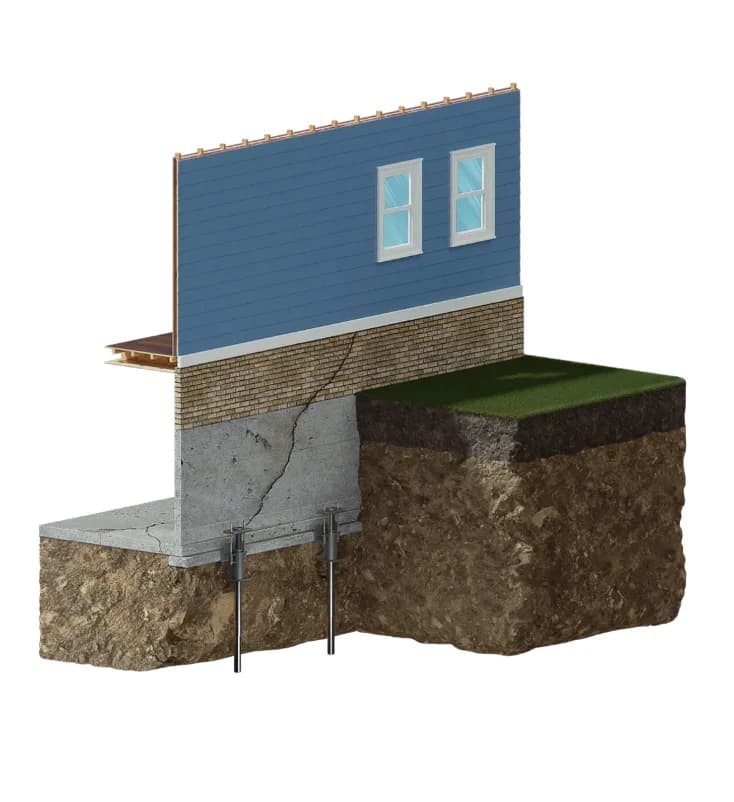
Hydraulic Push Piers
Push piers are steel tubes driven through the foundation footing down to stable bearing soil or bedrock beneath the expansive clay layer. Once the piers reach load-bearing depth, hydraulic jacks mounted on the piers lift the settled section of the foundation back toward its original position. Push piers are the standard solution for settling foundations on slab and raised foundations throughout Metro Atlanta. Most homes require 4 to 10 piers depending on the extent of the settlement.
Helical Piers
Helical piers use a screw-like steel shaft that is rotated into the ground until it reaches stable soil. They are used when the foundation load is lighter (such as porches, additions, and interior walls) or when the soil conditions make push piers less effective. Helical piers are also used for new construction foundation support on problematic soil. The installation is quieter and produces less vibration than push piers, which makes them suitable for work near sensitive structures.
Carbon Fiber Wall Reinforcement
When foundation walls bow inward from lateral soil pressure, carbon fiber straps bonded to the interior wall surface resist the bowing force and prevent further movement. Carbon fiber is stronger than steel per unit width, does not rust, and adds only a fraction of an inch to the wall thickness. This is the preferred solution for bowing basement and crawl space walls in Metro Atlanta homes where the bowing is 2 inches or less.
Crack Sealing and Injection
Foundation wall cracks are sealed with epoxy injection for structural cracks or polyurethane injection for water-leaking cracks. Epoxy restores the original strength of the concrete at the crack location. Polyurethane expands to fill the crack and any voids behind it, creating a waterproof seal that flexes slightly with seasonal movement. Most crack repairs are completed in a single day.
Slab Leveling
For slab-on-grade foundations where interior or exterior sections have settled, we inject high-density polyurethane foam through small holes drilled in the slab. The expanding foam fills the void beneath the slab and lifts it back to level. This is effective for garage floors, front stoops, walkways, and interior slab sections that have settled from soil washout or compaction beneath the slab.
Foundation Repair by City
Every city has unique soil conditions, housing stock, and foundation challenges. Select your city for pricing, methods, and FAQs specific to your area.
Lawrenceville
Gwinnett County
1980s-2000s homes on compacted fill soil. Clay settlement and pier failure.
Marietta
Cobb County
Historic pier-and-beam homes and hillside construction. Rocky clay mix.
Roswell
North Fulton
Chattahoochee corridor moisture, tree root damage, high-end homes.
Alpharetta
North Fulton
Newer homes on settling fill. Slab-on-grade and hybrid foundations.
Decatur
DeKalb County
Oldest housing stock in Atlanta. Original stacked stone pier foundations.
Sandy Springs
Fulton County
Split-level stress points, decomposed granite soil, hilly terrain.
Stone Mountain
DeKalb County
Granite substrata creating unpredictable water and cinder block deterioration.
Frequently Asked Questions
How much does foundation repair cost in Atlanta, GA?
Foundation repair in Metro Atlanta typically costs between $2,500 and $15,000. Minor crack sealing starts around $500 to $1,500. Push pier installation runs $1,000 to $2,500 per pier, and most homes need 4 to 10 piers. Wall stabilization with carbon fiber or steel braces costs $3,000 to $8,000 per wall. Full foundation restoration for severe damage ranges from $10,000 to $25,000. We provide free inspections with written estimates so you know the exact cost before any work begins.
What are the signs of foundation problems in Atlanta homes?
The most common signs include cracks in interior drywall (especially diagonal cracks near door and window frames), doors and windows that stick or no longer close properly, visible cracks in the exterior brick or foundation wall, gaps between the floor and baseboards, uneven or sloping floors, and chimneys pulling away from the house. If you notice any of these, a free inspection can determine whether the cause is normal settling or structural damage that needs repair.
Why do Atlanta homes have so many foundation problems?
Metro Atlanta sits on expansive red clay soil that swells when wet and shrinks when dry. This seasonal volume change creates a push-pull cycle beneath foundations that causes settling, cracking, and structural movement over time. Heavy rainfall (50+ inches per year), mature tree roots that pull moisture from the soil, and poor drainage around foundations all contribute. Homes built on improperly compacted fill soil during building booms are especially vulnerable.
How long does foundation repair take in Atlanta?
Most foundation repairs take 1 to 3 days for a typical Atlanta home. Push pier installation is usually completed in 1 to 2 days. Crack sealing and carbon fiber wall reinforcement are often same-day projects. Complex jobs involving multiple repair methods or extensive pier work may take 3 to 5 days. Your home remains livable throughout the repair process.
Does foundation repair come with a warranty?
Yes. All foundation repair work by Reliable Solutions Atlanta includes a transferable warranty that protects your investment and passes to the next homeowner if you sell. The warranty covers the specific repairs performed and gives both you and future buyers confidence that the foundation has been professionally addressed.
Should I fix foundation problems before selling my Atlanta home?
Yes. Foundation issues are among the most commonly flagged findings on home inspections in Metro Atlanta. Unresolved foundation problems can reduce offers by $10,000 to $40,000 or cause buyers to walk away entirely. Professional repair with documentation and transferable warranty eliminates this risk and often costs less than the price reduction you would face by selling without repairs.
Foundation Repair Resources
How Much Does Foundation Repair Cost in Atlanta?
Realistic pricing for piers, crack sealing, wall stabilization, and more.
Crack GuideTypes of Foundation Cracks and What They Mean
Learn which cracks are cosmetic and which signal structural problems.
Local InsightWhy Atlanta Homes Are Prone to Foundation Problems
How Georgia red clay soil creates unique challenges for homeowners.
DiagnosisFoundation Settling vs. Structural Damage
Know when settling is normal and when it signals a serious problem.
PreventionFoundation Maintenance: A Seasonal Checklist
Simple seasonal tasks to prevent costly foundation repairs.
Warning Signs6 Signs Your Concrete Needs Repair
Sunken concrete near your home can signal deeper foundation issues.
Free Foundation Inspection in Metro Atlanta
We will inspect your foundation, document the conditions with photos, explain what we find in plain language, and give you a written estimate. If you do not need repair, we will tell you that too. No obligation, no sales pressure.
BBB A+ Accredited · IICRC Certified · 20+ Years Experience · GreenSky Financing Available